
Insulated Beehive R-Value: R-6.93, Lab-Tested

R-6.93 Insulation
The R-value is a measure of thermal resistance: how well a material resists heat moving from the warm side to the cold side. The higher the R-value, the better the material insulates. The most noteworthy feature of our beehives is the insulation sealed inside the walls and top cover, which has an independently lab-tested R-value of 6.93. Apimaye is the only plastic insulated hive with an independently lab-tested R-value. Standard 3/4" pine used to build wooden beehives has an R-value of about 1.04, so an Apimaye wall insulates 6–7 times better than a wooden hive wall. A wooden hive would need walls about 5" thick to match. Double-wall insulation keeps the colony warmer in winter and cooler in summer, creating an ideal environment for the bees, especially in extreme climates like Arizona or New England. It reduces winter food consumption, which can help colonies enter spring with more of their stored food.
About the test
| Laboratory | TEBAR Test Certification R&D Inc., Istanbul, accredited by TÜRKAK, the Turkish Accreditation Agency (No. AB-0302-T) |
|---|---|
| Test standard | EN 12667, the European standard for measuring the thermal resistance of insulation (heat flow meter method) |
| What was tested | The polyurethane (PUR) foam insulation used inside Apimaye hive walls, 1.23" (31.3 mm) thick |
| Result | Thermal resistance 1.22 m²·K/W (metric) = R-6.93 (US units). Thermal conductivity 0.0257 W/m·K. |
| Report | No. R1600463, tested June 22–23, 2016 Download the full test report (PDF, 5 pages) |
R-values in the US are given in imperial units (ft²·°F·h/BTU), so the lab's metric result is converted: 1.22 × 5.678 = R-6.93. Today's hives use the same insulation formula and wall thickness as the tested sample.
Why do some hives advertise higher R-values?
Some hive makers publish a single R-value averaged across the whole hive, and count the empty air spaces inside the lid or under the frames as insulation. In practice, a sealed air space with ordinary, nonreflective surfaces is typically worth only about R-1 to R-1.5, even as the gap increases from ¾ inch to 3½ inches, because heat still crosses it, mostly as radiation from one surface to the other. Our R-6.93 is a lab measurement of the solid insulation in the hive walls, the part that surrounds the brood nest, backed by a published report from an accredited lab.
That insulation is also sealed inside a hard, UV-stabilized, food-grade plastic shell. The shell helps protect it from physical damage (such as hive tool scrapes), sunlight, moisture and insects, including wax moth larvae and bees, which can chew into exposed foam, over the hive’s service life.
When you compare hives, check what was measured and whether a lab test backs it up.
Want to see the science? Read the research on insulated beehives, including USDA and university studies on colony weight, hive temperature, winter survival and honey yield.
Moisture Control System
Apimaye's plastic shell resists moisture absorption and protects the insulation sealed inside. The hives also have built-in ventilation openings that let excess moisture escape, reducing the condensation that leads to mold, a common problem in wooden hives. The screened bottom board lets air in. The feeders on top of the hive have air slots around the edges that let moisture leave the hive body, and the telescopic top cover has slots in the front and back to let moisture out. In addition, the adjustable round entrances on the deep hive bodies can be used as a bee entrance or for ventilation.
Real-World Results
Check out this BroodMinder graph from one of our beekeepers in Palm Springs, CA. The outside temperature reaches above 110°F almost daily, yet the temperature inside the brood boxes stays steady at about 93–99°F.

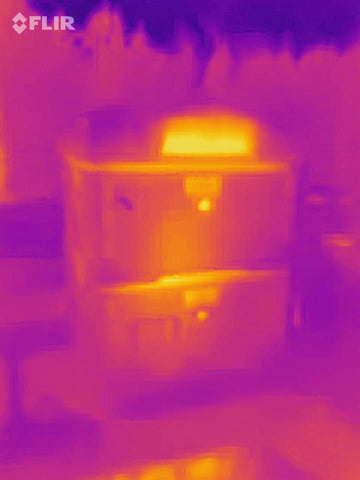
Insulation built into every Apimaye hive
Lab-tested R-6.93 wall insulation in a UV-stabilized plastic shell. Your wooden frames fit inside, and your 10-frame wooden boxes stack on top.
4.9 average across 279 Ergo hive set reviews · Free ground shipping over $50